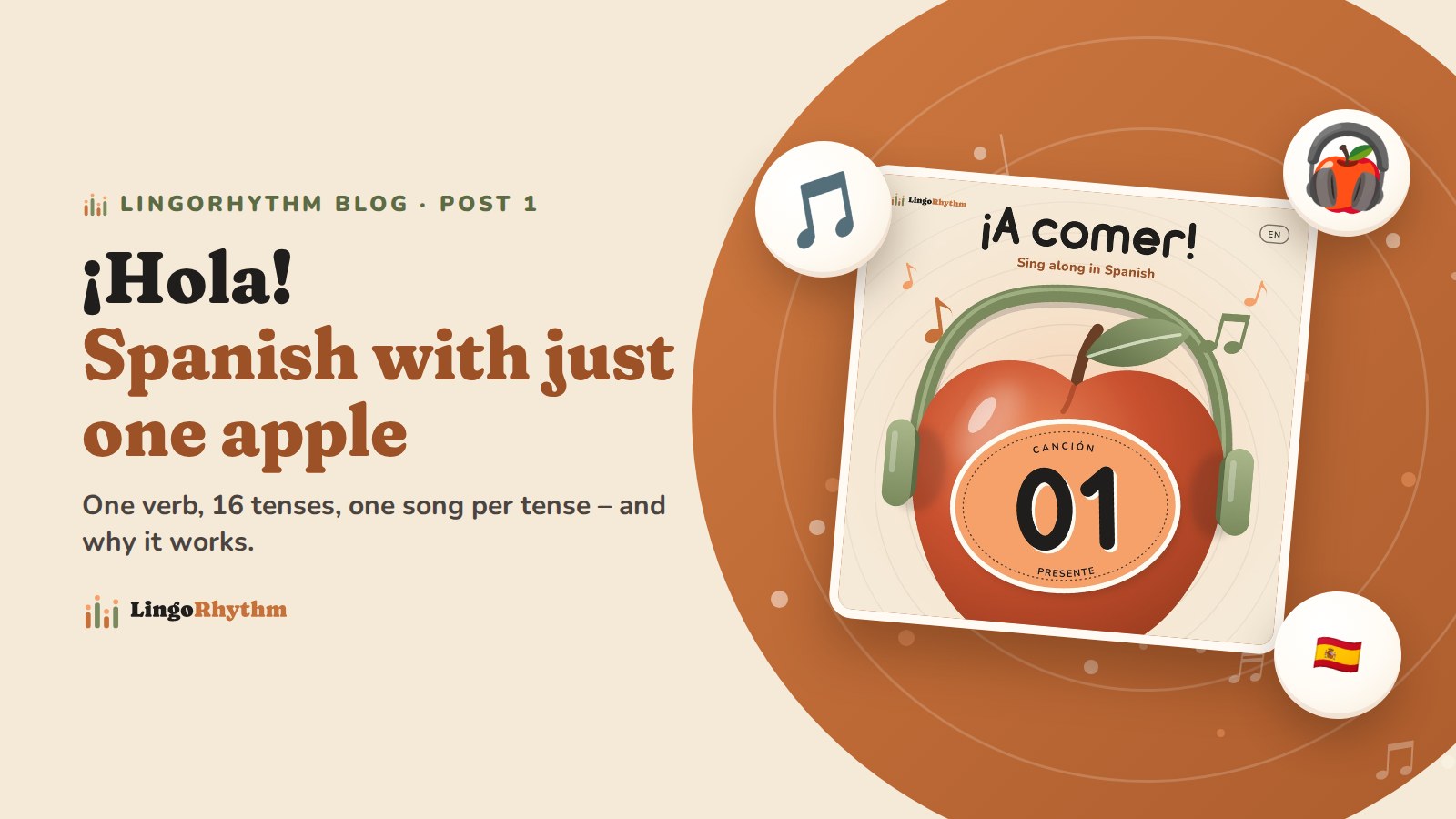
Welcome to the LingoRhythm blog! In this first post I want to tell you why everything here revolves around one single sentence – comer una manzana, to eat an apple – and why that is exactly what helps you learn.
How it all started
I am learning Spanish myself. And like many others, conjugation tables nearly drove me mad: six persons, sixteen tenses, plus irregular verbs. After a few pages everything blurs together.
So I built my own flashcards – simple enough for a child to understand. No jargon, pictures instead of rules, and a song for every tense. The idea comes from Tim Ferriss: a few well-chosen sentences reveal almost the entire skeleton of a language.
Those cards became LingoRhythm.
One verb, one apple, 16 tenses
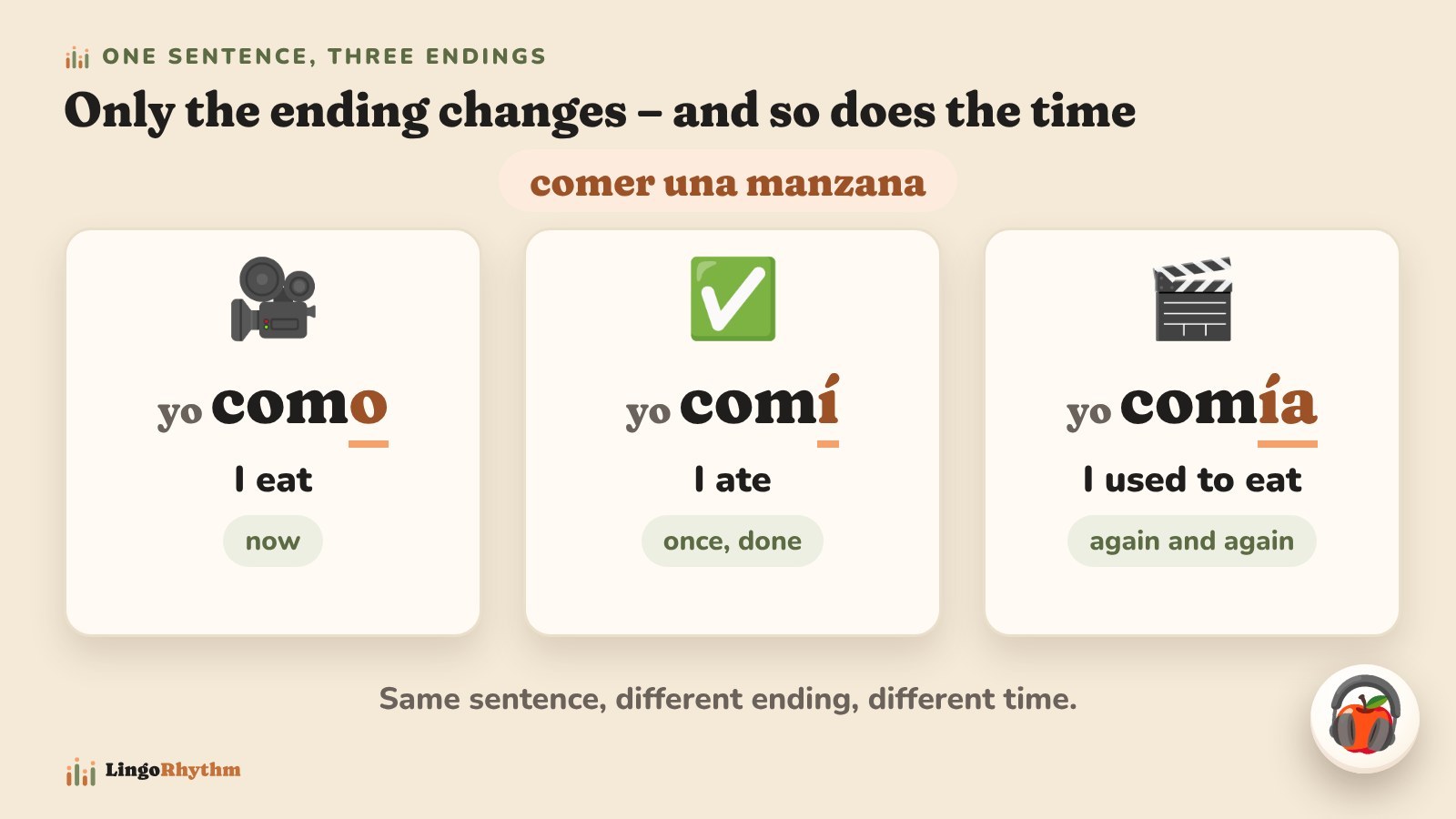
In ¡A comer! the sentence always stays the same: comer una manzana. Only the tense changes. You don’t have to learn new vocabulary and can focus entirely on what really changes – the ending.
- yo como – I eat (now)
- yo comí – I ate (once, done)
- yo comía – I used to eat
Same sentence, different ending, different time. Linguists call this principle “minimal pairs”: when two things differ in only one spot, the difference jumps out at you.
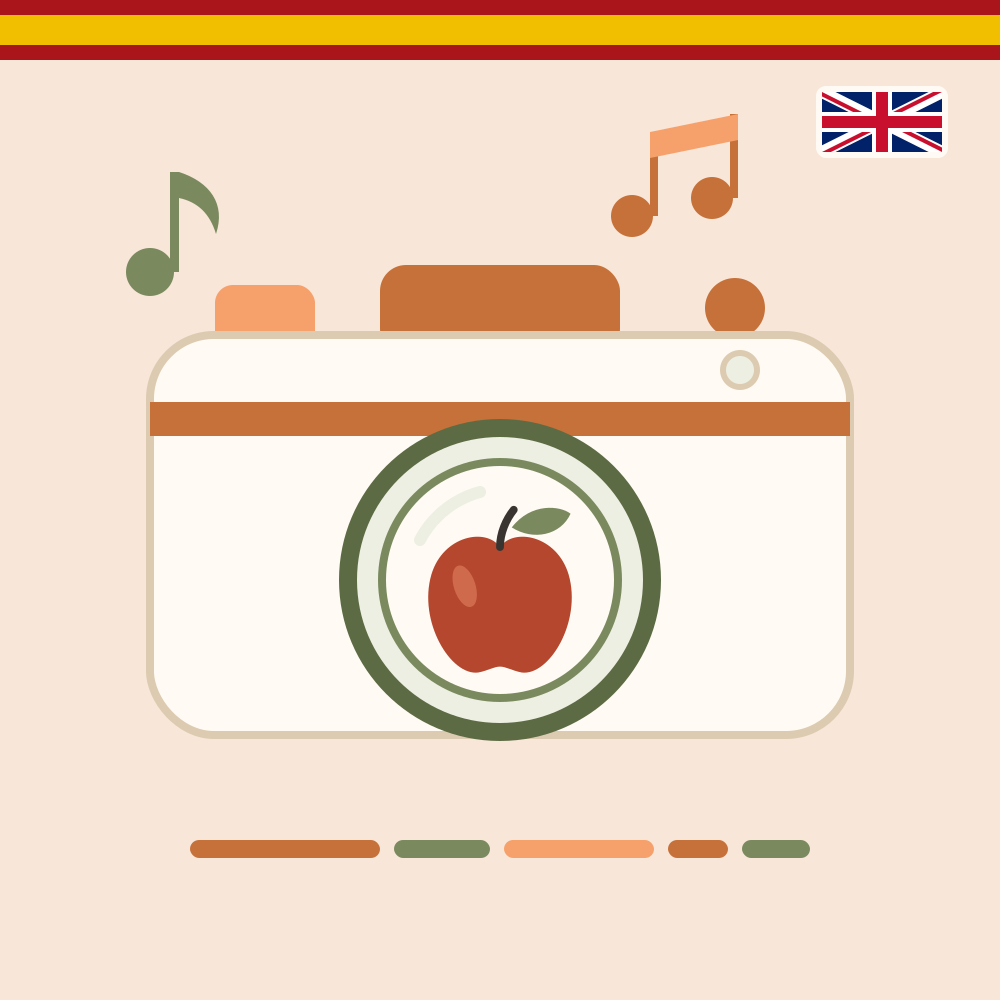
To help you remember when to use which tense, each one has its own picture: the Right-Now Camera for the presente, the Countdown Rocket for “about to”, the Memory Chest for “already today”, the Dream Cloud for anything that is only a wish. The picture explains the meaning, the ending carries the grammar.
Why music helps
Every lesson has its own song – upbeat Mediterranean music you’ll be humming along to by the second listen. That’s not a gimmick, it’s the method.
- Singing helps you remember. In a study at the University of Edinburgh, adults learned short Hungarian phrases. Those who had sung them recalled them best (Ludke, Ferreira & Overy, 2014).
- Short and often beats long and rare. Spreading the same material over several small sessions makes it stick much longer (Cepeda et al., 2006). That’s why you briefly review each lesson after 1, 3 and 7 days.
- Testing yourself beats rereading. That’s why every worksheet ends with an exercise “from memory” (Roediger & Karpicke, 2006).
A song to anchor it, a picture to understand it, an exercise to recall it – in small portions.
Made for neurodivergent minds
Whether it’s ADHD, autism or simply a mind that switches off at the sight of a grammar table: classic language teaching is often too much, too fast and too abstract. So every lesson is built so that nothing overloads you:
- One topic per lesson: one tense, one verb, one object
- Short sessions: 10 minutes are enough
- Pictures instead of jargon: every tense has an image that sticks
- Music and rhythm as memory aids
- Instant feedback on every exercise, no time pressure, no point deductions
- Calm, bright design with a clear structure and easy-to-read fonts
Important: this is learning material, not therapy. “Made for neurodivergent minds” describes how it is built – and in my experience it helps everyone who likes things clear and calm.
How to try it
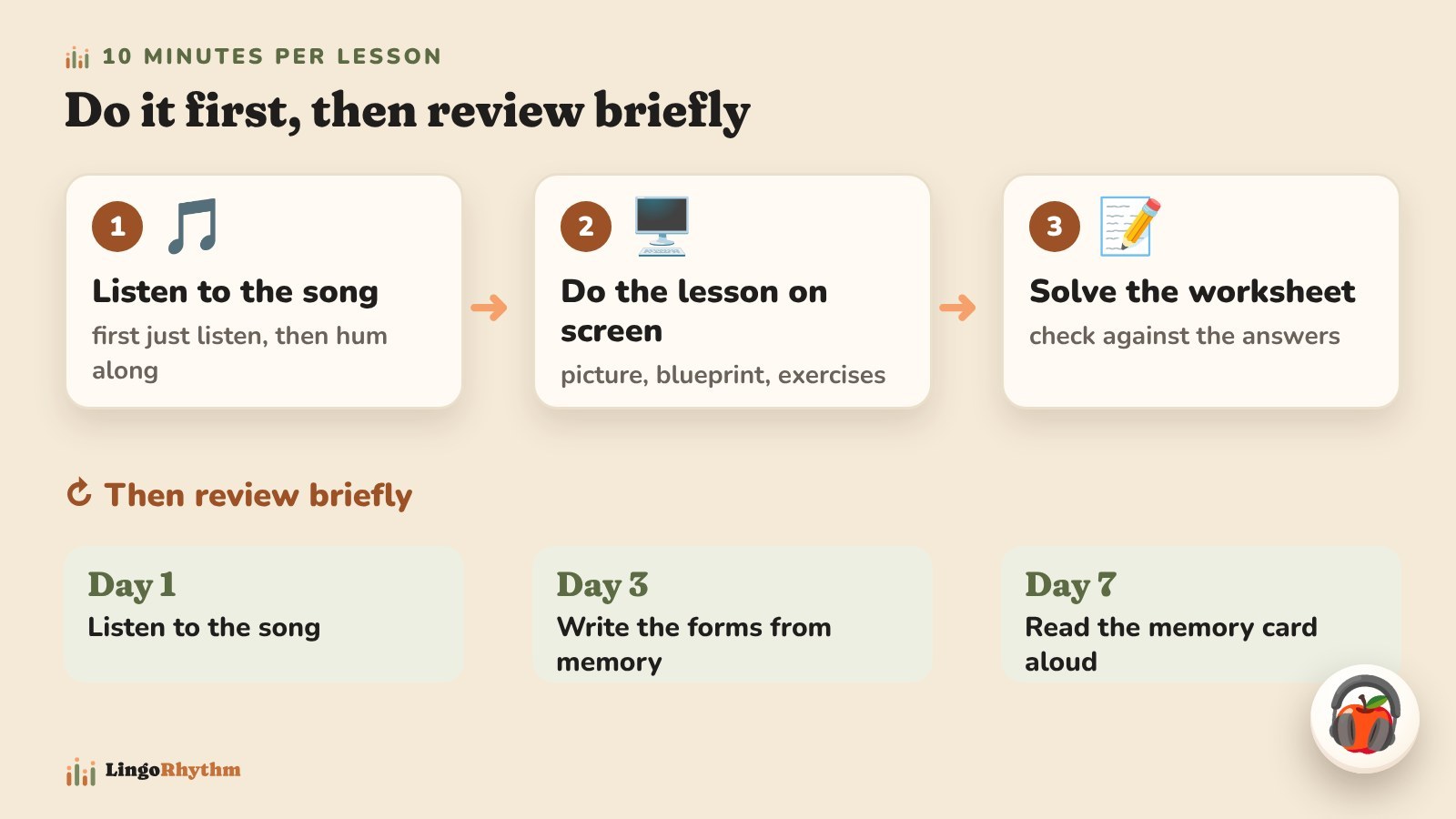
The best place to start is Lesson 01, the presente – the tense you hear in almost every Spanish conversation. Set aside 10 minutes:
- Listen to the song. Just listen the first time, hum along the second time.
- Do the lesson on screen. Look at the picture, understand the building plan, tap through the exercises.
- Solve the worksheet. Print it, fill it in, compare with the answers on the last page.
Then review briefly: after 1 day the song, after 3 days write the forms from memory, after 7 days read the memory card out loud. If you like, make the memory card your lock screen – then you learn along the way.
¡A comer! · Lesson 01
Learn the Spanish present with one song and one apple
yo como una manzana
I eat an apple, right now. Only the ending changes, and Lesson 01 shows you how: the Right-Now Camera snaps what is happening at this moment. One verb, comer, and 10 minutes are enough.
✔️ A song to sing along to (MP3)
✔️ An Interactive Lesson with instant feedback, no time pressure and no lost points
✔️ A printable Worksheet with answers
✔️ Explanation, Lyrics and Start Guide as short PDFs
✔️ Memory Cards for phone, tablet and monitor
€4.90 · instant download · Made for neurodivergent minds: one topic per lesson, pictures instead of jargon.
One lesson, one tense, one verb: not a complete textbook, and without irregular verbs. Learning material, not a medical product and not therapy; “Made for neurodivergent minds” describes the design, not a promise of a cure. For personal use only; sharing and resale are not permitted. © LingoRhythm.
What’s coming next
¡A comer! is just the beginning. Two more series are in the works for the other verb families: ¡A cantar! (cantar una canción, to sing a song) for -ar verbs and ¡A vivir! (vivir un sueño, to live a dream) for -ir verbs. The course is available with explanations in English, German and Chinese.
Here on the blog I’ll share learning tips, little games for home and news from the workshop. If you don’t want to miss anything, follow LingoRhythm in the shop – and if you have a question or a wish, just write to me. Bullet points are fine.
¡Hasta pronto!
Read this post in another language: